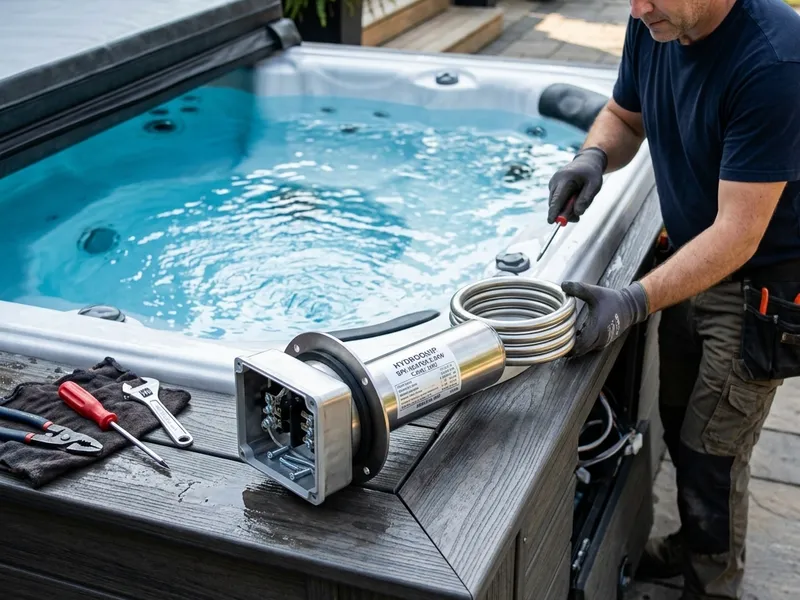
A hot tub heater replacement cost usually falls between $200 and $700 for a standard pro job. Most element swaps land between $230 and $500 once parts and labor are counted, while a full heater assembly runs higher, with the top end near $1,000. The final bill depends on whether the element alone or the whole heater is swapped.
Every figure in this guide is a typical, estimated range, not a price quote. Your contractor confirms the final price in a written quote after seeing the job, before any work starts.
The heater is the part that turns cold water into a hot soak. It is a metal tube with an electric element inside, and water flows past that element every time the pump runs. When the element burns out, the tub stays cold even though the pump, the jets, and the controls all still work. That is why a heater quote feels urgent in cold weather, and why it helps to know the price ranges before a technician arrives.
This guide covers the full price picture: parts, labor, and the choices that move the bill up or down. It builds on our general hot tub repair cost guide, which lists average prices for every major repair. Here we go deep on one job only, the heater, so you can judge any quote line by line.
What a New Heater Costs: Parts and Labor
Plan on $80 to $250 for the heater element itself, $150 to $250 for labor, and $230 to $500 in total for a typical element swap, based on the national averages in our general repair guide and on Angi 2026 figures. A full heater assembly, element plus housing tube, runs higher, and that is why quotes for one job can differ by hundreds of dollars.
| Job | Parts | Labor | Total |
|---|---|---|---|
| Diagnostic visit | None | Visit fee | $125 to $195 |
| Element swap | $80 to $250 | $150 to $250 | $230 to $500 |
| Full heater replacement | Higher, element plus housing | $150 to $300 | $500 to $1,000 |
The diagnostic fee is the visit charge for testing the heater, the wiring, the flow switch, and the control board to pin down the fault. Many technicians put that fee toward the final bill if you go ahead with the repair, so ask before you book.
An element swap keeps your existing heater housing tube, which is the metal tube the element slides into. A full heater replacement swaps the element and the housing tube together as one unit. The full swap costs more in parts, but it can save a second labor charge later if the old tube was already corroded or scaled up inside.
For the job itself, book hot tub heater repair service with a technician who works on spas, not a general plumber. Heater wiring runs at 240 volts, and the wiring, seals, and water flow all need spa-specific care.
What Pushes Hot Tub Heater Replacement Cost Up or Down
Three things move the price most: the type of heater, how much of it is replaced, and labor time. A larger high-wattage heater costs more than a small low-wattage element, and a tight equipment bay adds labor hours. Once you know those three facts about your tub, any quote becomes much easier to judge.
Heater type is the first factor. Hot tub heaters come in common wattages, often 4 kW or 5.5 kW, and in titanium or incoloy elements. A titanium element costs more than an incoloy one, but it resists corrosion better in saltwater and heavily chlorinated tubs. A heater that must match your tub's plumbing size and voltage costs more than a generic fit.
The scope of the swap is the second factor. An element-only swap is the cheapest path when the housing tube is sound. A full assembly swap costs more up front. A job that also needs new O-rings, unions, or a flow switch adds parts on top.
Access is the third factor. If the equipment bay is easy to reach, the swap is fast. If the technician must drain the tub, cut away foam, or work in a cramped corner, labor time grows, and the bill grows with it.
Local labor rates are the last factor. Rates run higher in large cities than in small towns, and an emergency or weekend call adds a premium. A weekday booking in normal hours is almost always the cheapest way to get the job done.
Repair the Heater or Replace It?
Replace the whole heater when the element is shorted and the housing tube is corroded or scaled through, because a new element will not fix a damaged tube. Repair makes sense for a failed flow switch, a tripped high-limit sensor, or loose wiring, when the element and the tube are still sound.
A flow switch job is the classic small repair. The flow switch tells the control board that water is moving, and the board only powers the heater when flow is confirmed. When the switch sticks, the heater never turns on, even though the element is fine. A switch swap is a small job that sits at the low end of the price range.
An element swap is the middle case. Elements burn out from low pH water, heavy scale, or running the heater with low water flow. The housing tube is often still sound, so swapping the element alone is the honest fix. Ask the technician to show you the failed element and explain why repair or replacement is the right call.
A full replacement is the right call when the housing tube is pitted, cracked, or leaking at the seals, or when the element has welded itself to the tube with scale. In those cases, patching one part leaves the next failure weeks away, and you pay labor twice.
Signs Your Heater Needs Replacement, Not a Quick Fix
Water that will not heat past a set point
A tub that climbs to 90 or 95 degrees and stops, no matter how high you set the target, often has a dying element. The element still draws some power, but it cannot produce full heat. Turn the heater off at the breaker and book a test before the element shorts and takes the control board with it.
Need Professional Hot Tub Repair?
We have local technicians available nationwide.
Breaker trips when the heater kicks in
A tub that runs fine on jets but trips its GFCI breaker the moment the heater tries to engage has a short in the element or water inside the heater tube. This is an electrical fault, not a setting you can reset away. Keep the breaker off and call a technician, since water and 240-volt power are a dangerous mix.
Error codes that point at the heater
Codes like OH, HH, or a flashing heat light often mean the heater is overheating or the sensors disagree about the water temperature. Our hot tub not heating guide walks through the checks that separate a sensor fault from a dead element, so you can tell a cheap fix from a replacement before you book.
Visible corrosion or a leaking heater tube
A white crust on the heater unions, green corrosion on the terminals, or a steady drip from the heater tube itself points to a housing that is failing. Our hot tub leak repair guide explains how to tell a fitting drip from a heater leak, and when a leak needs a pro at once.
If the jets are weak as well as the water is cold, read our hot tub jets not working guide first. Jets can fail from air locks, clogged filters, or stuck diverter valves, and none of those need a new heater.
How the Replacement Job Works
A standard heater swap follows the same steps, and knowing them helps you spot a rushed job.
- The technician cuts power at the breaker and confirms the circuit is dead with a meter.
- The tub is drained below the heater level, or the slice valves are closed if your tub has them.
- The wiring, bonding wire, and unions are disconnected, and the old heater is lifted out.
- The new heater is set in place, plumbed, wired, and sealed, with new O-rings on the unions.
- The tub is refilled, the pump is primed to clear trapped air, and the heater is tested through a full heat cycle.
The whole visit often takes one to three hours, plus drain and refill time. If the new heater will not fire, trapped air is the usual cause, and the technician bleeds it from the pump union. A heater that will not fire after bleeding may have a flow fault or a sensor fault that needs a closer look.
One note on water flow: a heater cannot heat water that never reaches it. If the circulation pump is dead, the heater will not run at all, and a new element will not fix a cold tub. Our guide to hot tub pump replacement cost covers that job in full.
How to Keep the Bill Down Without Cutting Corners
A low quote is not always a good deal, and a high quote is not always a rip-off. The safest way to save is to compare like with like.
Ask for an itemized quote that splits parts from labor. Ask whether the price covers an element only or a full heater assembly, and whether the part is an original maker part or a quality aftermarket part. For a standard 5.5 kW element, a good aftermarket part is often fine. For a brand-specific heater or a saltwater tub, the original part is the safer buy.
Fix water chemistry fast. Low pH water eats heater elements, and high calcium leaves scale inside the housing tube. Test the water weekly, keep the pH in range, and rinse and clean the filter on schedule, since a clogged filter starves the heater of flow and makes the element run hotter than it should.
Never bypass a flow switch or a high-limit sensor to "see if the heater works." Those parts shut the heater off to stop it from boiling the water or melting the plumbing. Bypassing them can destroy the heater, the control board, or the tub itself. Switch the power off at the breaker and book the repair. That one habit saves more heaters than any other.
Questions Owners Ask About Heater Replacement
Can I replace just the element and keep the old heater tube? Yes, when the housing tube is sound, the seals are tight, and the terminals are clean. The technician inspects the tube for pitting and scale before reusing it. If the tube is corroded or the seal seat is scored, a full assembly is the better buy.
How long will a new heater last? A new heater lasts longest when water chemistry stays balanced and the filter stays clean. Low pH water eats elements, scale coats the tube, and a clogged filter starves the heater of flow. Good water care is the cheapest heater insurance there is.
Will a new heater fix my cold tub? Only if the heater was the cause. A cold tub can also come from a dead circulation pump, an air lock, or a failed flow switch, and none of those need a new heater. A technician should test flow and voltage before selling you a heater, and our not-heating guide above lists the checks to run first.
Is a heater swap a job I can do myself? The plumbing is simple, but the wiring is not. You are working with 240 volts inches from hundreds of gallons of water, and a wiring error can destroy a control board or cause a fire. For most owners, a licensed spa technician is the right call, and the labor charge buys both safety and a warranty on the work.
The Bottom Line
In the end, hot tub heater replacement cost comes down to three choices: element only or full assembly, standard or brand-specific parts, and a weekday booking or an emergency call. A typical element swap runs $230 to $500, a full heater swap runs $500 to $1,000, and a diagnostic visit runs $125 to $195.
Get the quote itemized, ask what is being replaced and why, and keep the water chemistry balanced so the new element lasts. Then find local hot tub repair help and book the job in normal hours. A clear quote and a warm tub are worth more than the cheapest price on the page.