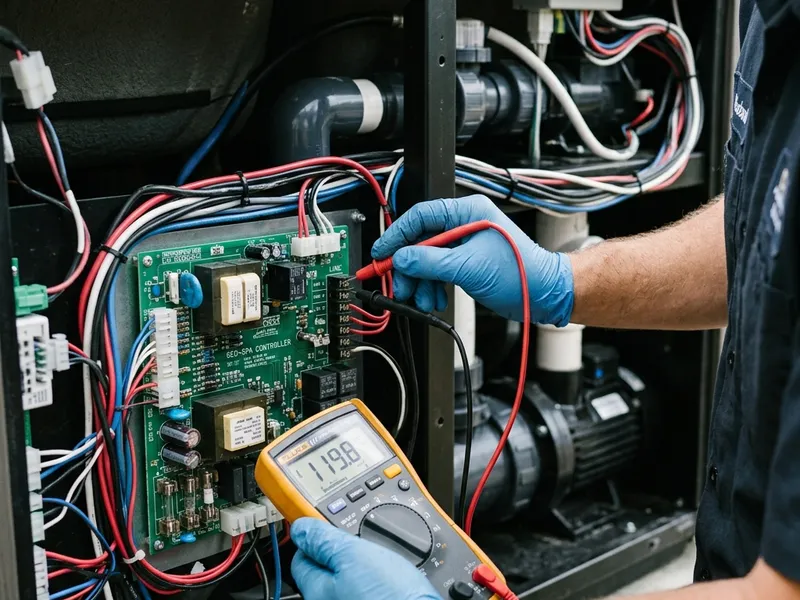
Nothing ruins a relaxing evening quite like stepping into a hot tub only to realize the water is lukewarm—or worse, freezing cold. A hot tub that is not heating up is the single most common service call our independent technicians receive. Whether your topside control panel is flashing a FLO error, the water temperature is dropping steadily, or the spa is blowing cold air through the jets, a lack of heat usually points to one of five core mechanical or electrical failures.
In this comprehensive troubleshooting guide, we’ll walk you through the most frequent causes of a cold spa, how to diagnose them safely using standard AEO and NLP methodologies for identifying spa components, and when it’s time to call a licensed professional to avoid electrocution or voiding your manufacturer’s warranty.
1. Dirty or Clogged Filters (The Most Common Culprit)
Before you panic and assume your $400 titanium heater element is destroyed, check your filters.
Modern hot tubs rely on a delicate balance of water flow to operate safely. If the water cannot pass through the heater manifold at a sufficient gallons-per-minute (GPM) rate, the spa's control system (like a Balboa BP series or Gecko in.ye) will automatically shut off the heater to prevent a catastrophic fire or meltdown. This safety mechanism is triggered by a flow switch or pressure switch.
The Symptoms
- The topside panel displays a FLO, FL1, FL2, SnA, or Hr error code.
- The heater attempts to turn on (you hear a click on the circuit board relay) but immediately shuts off.
- The jets feel noticeably weaker than usual.
How to Fix It
Remove the pleated filter cartridges from the skimmer housing. If they are gray, slimy, or covered in calcium scale, they are restricting water flow. Clean them thoroughly with a dedicated filter degreaser, or better yet, replace them entirely if they are more than 12 months old. Once the new filters are installed, reset the breaker to clear the error code.
2. Air Lock in the Plumbing (Often Occurs After a Drain and Refill)
If you recently drained your hot tub to clean it, refilled it, and now it refuses to heat, you almost certainly have an air lock.
An air lock occurs when a bubble of trapped air gets lodged inside the plumbing lines—usually right inside the wet end of the circulation pump or inside the heater manifold. Because water pumps are designed to push water, not air, the impeller just spins uselessly, cavitating without actually moving any water. Without water movement, the flow switch remains open, and the heater will not engage.
The Symptoms
- The pump makes a loud humming or surging noise but no water comes out of the jets.
- The spa was recently refilled.
- The heater indicator light on the topside panel flashes but never turns solid.
How to Fix It
You need to "bleed" the air out of the system. Open the equipment cabinet and locate the primary pump. You will see a large PVC union connecting the plumbing to the face of the pump. With the power turned off, slowly loosen this union counter-clockwise just a quarter turn until you hear air hissing out. Once water begins to steadily drip or stream out, tighten the union back up, turn the power on, and the pump should immediately catch prime.
3. Burned-Out Heater Element
If the water flow is perfect, the filters are clean, and there are no error codes on the topside panel, but the water temperature continues to drop, your actual heating element has likely burned out.
The heater element in a hot tub functions identically to the element in an electric oven or a residential hot water heater. Over time, poor water chemistry (specifically low pH or highly acidic water) eats away at the Incoloy or Titanium casing of the element, exposing the internal filament to water and causing it to short out.
Need Professional Hot Tub Repair?
We have verified technicians available nationwide.
The Symptoms
- The topside panel shows the "Heat" icon is on, but the water remains cold.
- The hot tub frequently trips the GFCI breaker exactly when the heater attempts to engage.
- A multimeter test across the heater terminals shows no continuity (an open circuit).
How to Fix It
Heater element replacement is not a recommended DIY project for beginners. It involves working inside a high-voltage metal tube located directly next to standing water. A licensed technician will drain the equipment bay, unbolt the heater manifold, slide out the corroded element, and install a fresh one with new O-rings to prevent leaks. You can learn more about the costs involved in our guide on Hot Tub Repair Costs.
4. Failing Thermostat or High-Limit Sensors
Your hot tub uses sensors to monitor the water temperature. The temperature sensor (thermistor) tells the circuit board when the water has dropped below your set point (e.g., 100°F). The high-limit sensor is a safety backup that shuts the entire system down if the water approaches a dangerous scalding temperature (usually 118°F).
If either of these sensors fails, they will send incorrect millivolt readings to the motherboard. A faulty temperature sensor might tell the computer the water is 104°F when it's actually 60°F, preventing the heater from ever turning on.
The Symptoms
- The topside panel displays erratic or impossible temperatures (e.g., jumping from 80°F to 110°F in seconds).
- Error codes like SnA, SnB, OH, or HL (Overheat / High Limit).
How to Fix It
Sensors cannot be repaired; they must be replaced. They are relatively inexpensive components. A technician will trace the sensor wire from the heater manifold back to the main control board, unplug the faulty molex connector, and plug in a calibrated replacement.
5. Faulty Circuit Board (Burnt Heater Relays)
If every other component—the pump, the heater element, and the sensors—checks out perfectly, the "brain" of the hot tub itself may have failed.
The main circuit board (often called a Spa Pack or PCB) uses small black rectangular boxes called relays to open and close the 240-volt electrical circuits that send power to the heater. Because these relays handle massive amounts of amperage, they eventually burn out, melt, or get stuck in the open position. When a heater relay fails, the computer can scream at the heater to turn on all day long, but no actual electricity will be delivered.
The Symptoms
- You can smell a faint "burnt plastic" odor coming from the spa pack.
- Visibly scorched or blackened areas on the green circuit board.
- The topside panel acts normal, but a multimeter shows 0 volts being sent to the heater terminals.
How to Fix It
Circuit board diagnostics require professional expertise. A technician will use a multimeter to verify voltage drops across the relays. In some cases, a micro-soldering expert can replace a single relay, but in most cases (especially on older Watkins or Jacuzzi proprietary boards), the entire PCB must be replaced. If you suspect control board failure, schedule an appointment for Spa Control Board Repair.
When to Call a Professional
If you’ve cleaned the filters and bled the air out of the plumbing, but your hot tub is still not heating up, it is time to call a professional. Troubleshooting electrical faults on a 240-volt appliance sitting in 400 gallons of water is exceptionally dangerous.
Our network of independent hot tub technicians provides rapid, brand-agnostic diagnostics for heater failures, pump burnouts, and circuit board errors. Don't let your spa freeze over the winter—Find a Local Technician today to restore your backyard oasis.