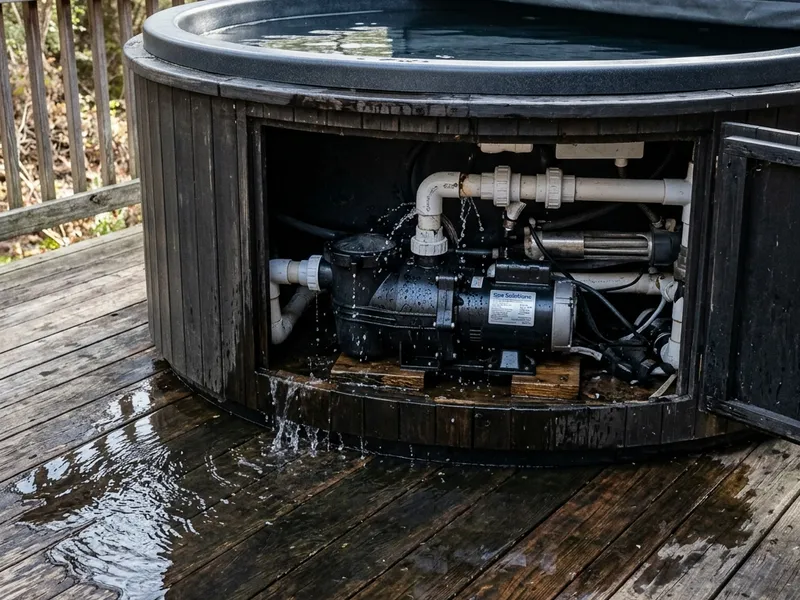
Finding the Source of a Hot Tub Leak
Walking out to your patio and stepping into a puddle of water radiating from beneath your hot tub is a sinking feeling. A hot tub leaking from the bottom is one of the most common issues owners face, but tracking down the exact source of that leak can be incredibly frustrating.
Because a hot tub cabinet is tightly packed with pumps, heaters, and dozens of PVC plumbing lines, water from a leak will often run along the pipes, dripping down into the equipment bay far away from the actual crack.
In this guide, we will walk you through the professional process of isolating a hot tub leak, the most common components that fail, and when you need to call a technician.
Step 1: Determine the Severity of the Leak
Before taking the cabinet panels off, determine how much water you are actually losing.
- Evaporation: It is normal to lose up to an inch of water a week due to evaporation, especially in dry, windy climates or if you leave the cover off frequently.
- The Puddle Test: If there is a visible puddle, dry it completely with a towel. Wait 24 hours with the tub running. If the puddle returns aggressively, you have an active plumbing leak.
Step 2: Open the Equipment Bay
Shut off the main GFCI breaker before doing anything else. Water and 240-volt electricity are a deadly combination.
Remove the front cabinet panel (usually located below the topside control panel). This will give you access to the "Equipment Bay," which houses the primary jet pumps, the circulation pump, the control box, and the heater. Shine a bright flashlight inside. Look for active dripping, white calcium/scale buildup (which indicates a long-term slow leak that has calcified), or rust on the pump motors.
Need Professional Hot Tub Repair?
We have verified technicians available nationwide.
The Most Common Culprits
1. The Heater Unions (The Easiest Fix)
Hot tub heaters are connected to the PVC plumbing using large, threaded plastic nuts called unions. Inside these unions are rubber O-rings or gaskets that create a watertight seal.
- The Problem: As the heater expands and contracts with extreme temperature swings, these union nuts frequently vibrate loose. Additionally, high chlorine levels will eventually eat away at the rubber O-rings, causing them to degrade and leak.
- The Fix: If you see water dripping from the large plastic nuts on either side of the stainless steel heater tube, try tightening them by hand (do not use a wrench, you will crack the plastic). If they are tight but still leak, the system must be drained, the union opened, and the $5 rubber gasket replaced.
2. Pump Wet End Seals (The Most Common Mechanical Leak)
A hot tub pump consists of an electrical motor attached to a plastic housing called the "wet end." The shaft of the motor goes into the wet end to spin the impeller. A ceramic and carbon mechanical seal prevents water from escaping along that spinning shaft.
- The Problem: Poor water chemistry (especially acidic water) destroys these mechanical seals. If you see water dripping directly from the middle of the pump—right where the black metal motor meets the plastic housing—the seal has failed.
- The Fix: The pump must be removed from the spa. The wet end must be disassembled, and a new mechanical seal pressed in. Because this requires specialized pullers and presses, many technicians opt to simply replace the entire front wet end of the pump.
3. Circulation Pump Failure
If your spa has a small, dedicated 24-hour circulation pump (like a Laing or Grundfos), check it carefully.
- The Problem: These pumps run constantly, meaning they experience immense wear and tear. When they leak, they often leak directly into their own internal electronics, shorting them out.
- The Fix: Most modern circulation pumps are sealed, magnetic-drive units. They cannot be rebuilt. If a circulation pump is leaking, the entire pump must be replaced.
4. Manifolds and Jet Bodies (The Nightmare Scenario)
If the equipment bay is completely bone dry, but water is still pooling around the outside of the cabinet, you likely have a leak in the foam-insulated plumbing.
- The Problem: Water is pumped to the individual jets through complex PVC manifolds that split a single 2-inch pipe into dozens of 3/4-inch pipes. If the tub freezes in the winter, the expanding ice will shatter these manifolds or crack the plastic jet bodies attached to the acrylic shell.
- The Fix: This is the most labor-intensive repair in the industry. A technician must systematically remove the side panels and dig through hundreds of pounds of dense, wet polyurethane spray foam to track the water back to the cracked pipe. Once found, the pipe must be cut out, re-plumbed, and re-foamed.
The Dye Test
If you suspect a leak in a specific jet body but can't see behind the foam, you can perform a dye test. With the pumps turned OFF, squirt a small amount of dark food coloring or specialized pool leak dye near the suspected jet inside the tub. Watch carefully. Because the tub is leaking water out through the crack, the dye will be sucked directly into the crack, revealing the exact location of the failure.
Should I Use "Fix-a-Leak" Liquids?
You will see products online like "Fix-A-Leak" that claim to seal hot tub plumbing magically by pouring a liquid into the water.
- Professional Advice: We strongly advise against using these products. They work by coagulating when exposed to air. While they might plug a microscopic pinhole leak for a few weeks, they will also coagulate inside your heater element, your pump impellers, and your filter cartridges, causing massive mechanical damage. They are a temporary bandage that often causes thousands of dollars in permanent damage.
Conclusion
If your hot tub is leaking, time is of the essence. A slow drip onto a pump motor will rust the bearings and destroy a $400 motor in a matter of weeks. Furthermore, a severe leak can drain the tub below the heater intake, causing a dry fire that ruins the control board.
If the leak is not coming from a simple heater union that you can hand-tighten, call a professional. Our network of technicians can quickly trace the source of the leak, replace the failed seal or PVC component, and get your spa watertight once again.